
HOME | ACR
VRV/VRF
Our copper tubes are specially designed and approved for VRV / VRF air conditioning systems and are trusted by leading HVAC brands worldwide. Manufactured with high-quality copper and strict process control, our tubes ensure superior performance, reliability, and long service life in high-pressure and continuous-operation environments typical of VRV / VRF systems.
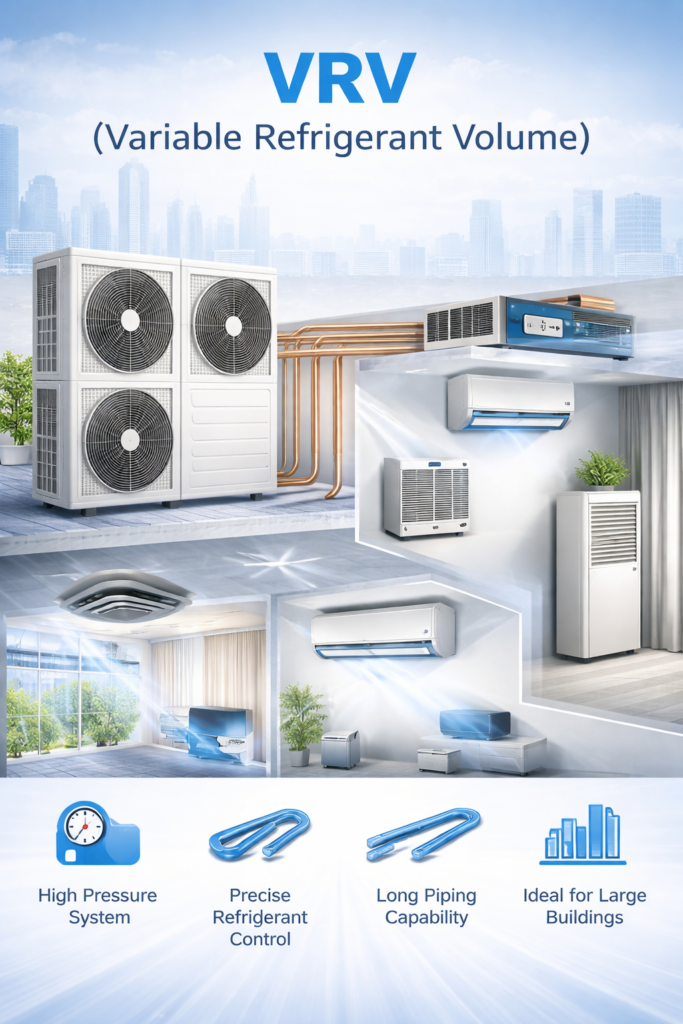
VRV systems are advanced air conditioning solutions designed to deliver precise cooling and heating by controlling the flow of refrigerant according to demand. VRV systems require high-quality copper tubes to handle high pressure, long piping lengths, and continuous operation. Our copper tubes are specially manufactured for VRV applications, ensuring excellent durability, efficient refrigerant flow, and long-term performance in residential, commercial, and large infrastructure projects.
Key Points – VRV Systems:
✔ Designed for high-pressure VRV air conditioning systems
✔ Ensures smooth and efficient refrigerant flow
✔ Suitable for long piping lengths and complex installations
✔ High strength and leakage-free performance
✔ Excellent bending & brazing properties
✔ Improves overall system efficiency and reliability
✔ Widely used in offices, hotels, malls, hospitals & high-rise buildings
VRV systems energy-efficient air conditioning solutions hain jo load ke according cooling provide karte hain. In systems ke liye strong aur reliable copper tubing zaroori hoti hai, jo high pressure ko handle kare aur long-term, trouble-free performance ensure kare.
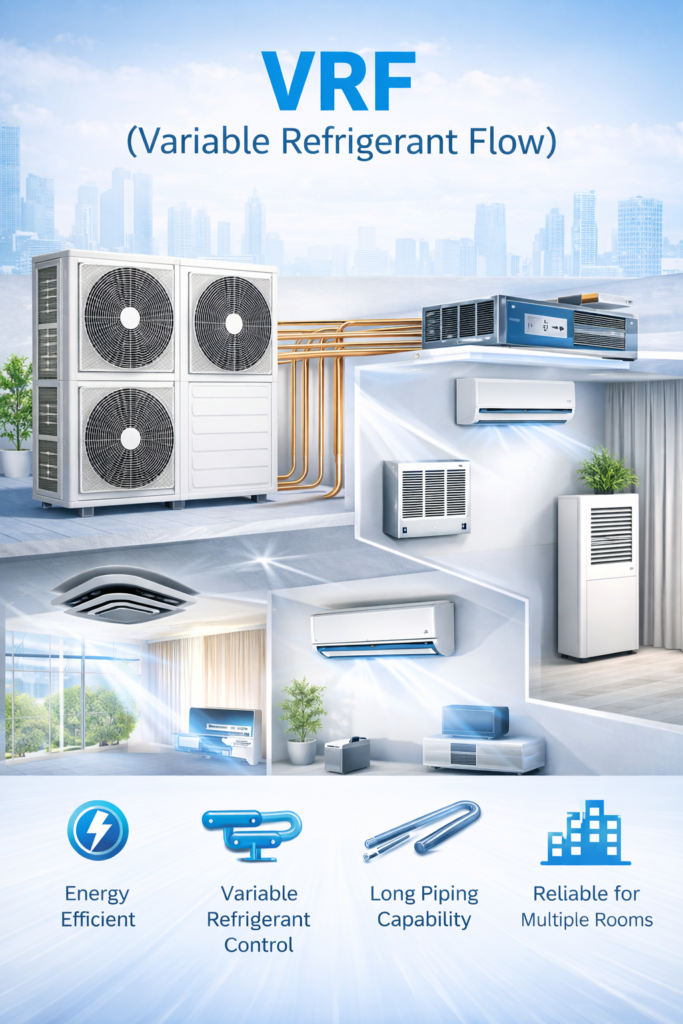
VRF ek modern air conditioning system hai jisme refrigerant ka flow indoor units ki requirement ke according adjust hota hai. Yeh system energy efficient hota hai aur stable cooling performance deta hai, isliye VRF installations me high-quality copper tubes ka use bahut important hota hai jo pressure aur long piping ko safely handle kar saken.
Points – VRF System:
✔ Energy-efficient air conditioning system
✔ Variable refrigerant flow control
✔ Long piping ke liye suitable
✔ High-pressure resistance required
✔ Reliable & leak-free copper tubing needed
✔ Residential & commercial use
VRF systems precise temperature control ke liye design kiye jaate hain jahan ek outdoor unit multiple indoor units ko efficiently operate karta hai. Is system me smooth refrigerant flow aur pressure handling bahut important hota hai, isliye VRF applications ke liye high-quality copper tubes use kiye jaate hain jo long-lasting aur dependable performance dete hain.
VRV / VRF System Installation Process
VRV (Variable Refrigerant Volume) and VRF (Variable Refrigerant Flow) systems are advanced air conditioning solutions widely used in residential complexes, commercial buildings, hotels, hospitals, offices, and high-rise projects. These systems operate with one outdoor unit connected to multiple indoor units, allowing precise control of refrigerant flow based on cooling or heating demand.
The performance, efficiency, and lifespan of a VRV/VRF system depend heavily on proper installation. Incorrect installation can lead to refrigerant leakage, poor efficiency, frequent breakdowns, and compressor failure. Below is a detailed step-by-step explanation of how VRV / VRF systems are installed correctly.
1. Site Survey and System Planning
The installation process begins with a detailed site survey. This step is critical to ensure proper system design and compliance with manufacturer guidelines.
During site survey:
Building layout and room dimensions are analyzed
Indoor and outdoor unit locations are finalized
Maximum piping length and height differences are calculated
Electrical load and power supply availability are checked
Drain routes and piping paths are planned
All planning must strictly follow the manufacturer’s technical limits for piping length, elevation difference, and capacity ratio.
2. Indoor Unit Installation
VRV / VRF indoor units are available in different types such as cassette, ductable, wall-mounted, ceiling-suspended, and floor-mounted units.
Installation steps:
Indoor units are fixed using proper hanging rods or mounting brackets
Units are leveled correctly to ensure smooth drainage
Adequate service clearance is maintained for maintenance
Drain piping is installed with proper slope to avoid water backflow
Correct alignment and vibration-free installation are essential to avoid noise and performance issues.
3. Outdoor Unit Installation
Outdoor units are generally installed on rooftops, balconies, or open ground areas with proper ventilation.
Key considerations:
Strong foundation or concrete base is required
Sufficient airflow clearance must be maintained
Anti-vibration rubber pads are used
Outdoor units should be protected from direct sunlight and heavy rain
Proper placement ensures efficient heat exchange and long-term reliability.
4. Copper Piping Installation (Critical Step)
Copper piping installation is the most important part of VRV / VRF systems.
Key guidelines:
Only high-quality refrigeration-grade copper tubes should be used
Pipes are cut cleanly and deburred properly
Sharp bends and unnecessary joints are avoided
Adequate pipe supports are installed to prevent sagging
Brazing Process
All pipe joints are connected by brazing
Nitrogen purging is done during brazing to prevent oxidation
Proper brazing alloys are used
Overheating of pipes is avoided
Poor brazing is one of the most common causes of VRV/VRF system failure.
5. Pipe Insulation Work
Insulation is essential to maintain energy efficiency and prevent condensation.
Both suction and liquid lines are insulated
Closed-cell elastomeric insulation is used
Insulation joints are sealed properly
Outdoor piping uses UV-resistant insulation
Proper insulation reduces energy loss and protects the system from moisture-related issues.
6. Electrical Wiring and Control Cabling
After piping and insulation:
Power cables are connected to indoor and outdoor units
Communication cables are installed as per wiring diagram
Proper earthing is ensured
Cable routing is done neatly and safely
Incorrect wiring can cause communication errors or damage electronic components.
7. Pressure Testing
Pressure testing ensures that the piping system is leak-free.
Procedure:
Nitrogen gas is filled into the system
The system is pressurized as per manufacturer specifications
All joints are checked using soap solution
Pressure is held for a specified time
If any leakage is detected, it must be repaired before proceeding.
8. Vacuuming (Dehydration Process)
Vacuuming removes air and moisture from the system.
Steps:
A high-capacity vacuum pump is connected
Vacuum is pulled until required micron level is achieved
System is held under vacuum to ensure stability
Moisture inside the system can cause acid formation and compressor damage, so vacuuming is extremely important.
9. Refrigerant Charging
After successful vacuuming:
Refrigerant specified by the manufacturer is charged
Additional refrigerant is added based on piping length
Charging is done using a weighing scale for accuracy
Overcharging or undercharging can seriously affect system performance.
10. System Commissioning and Testing
Commissioning is the final operational stage.
Checks include:
Starting the system in cooling and heating modes
Monitoring pressures, temperatures, and current
Checking error codes and communication signals
Testing individual indoor units
Controller settings and system parameters are configured at this stage.
11. Handover and Documentation
Once testing is complete:
System operation is explained to the client
Maintenance guidelines are provided
Test reports, drawings, and warranty documents are handed over
This ensures smooth operation and long-term system reliability.
Conclusion
VRV / VRF system installation is a highly technical process that requires skilled technicians, proper planning, and high-quality materials. Special attention must be given to copper piping, brazing, pressure testing, vacuuming, and refrigerant charging, as these directly impact system efficiency and lifespan. When installed correctly, VRV / VRF systems deliver superior comfort, energy efficiency, and long-term performance for modern buildings.
Get In Touch with Us!
Office Email
sales.rmetals73@gmail.com
info@rajasthanmetals.com
Office Phone
+91 9990942884
+91 9312211418
Office Address
B-34/6,2nd Floor, GT Karnal Road ind. Area,Delhi